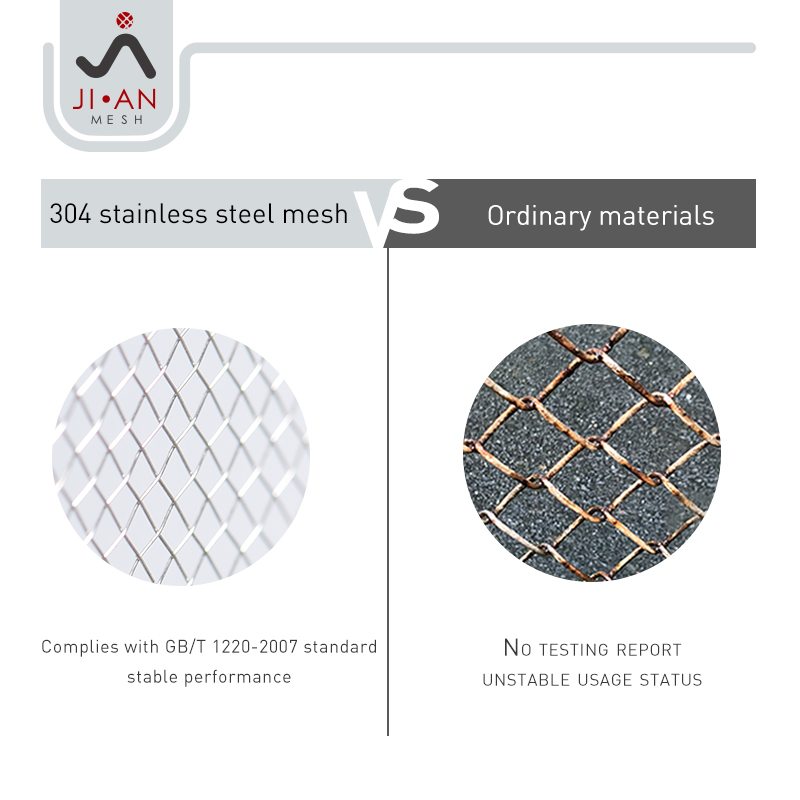
In architectural fenestration procurement, buyers often ask: "Why does genuine Grade 304 stainless steel security mesh develop brownish surface rust spots after two years? How many hours can stainless steel wire mesh withstand in Neutral Salt Spray (NSS) testing? Why does woven wire mesh show corrosion earlier than flat steel plates?" As a dedicated stainless steel mesh manufacturer, Ji'an Screen Mesh delivers a technical breakdown of passive film chemistry, salt spray test benchmarks, and the 6 common triggers of superficial rust.
1. Neutral Salt Spray (NSS) Test Truth & Structural Mechanics
Verified Testing Benchmark: Ji'an Screen Mesh Grade 304 stainless steel security screens achieve 96 hours in standard Neutral Salt Spray (NSS) testing. Customized test hours can be evaluated and certified based on project procurement volumes.
Why Does Woven Wire Mesh Corrode Earlier Than Flat Sheet Metal?
Interlacing Crevices: Overlapping warp and weft intersections trap and concentrate moisture and airborne salts.
Weaving Friction: Mechanical loom friction during high-tension weaving may cause micro-abrasions on the passive film or powder coating.
Large Specific Surface Area: Ultra-fine wire diameters exhibit an exponentially higher exposed surface-area-to-mass ratio.
Exposed Cut Edges: Sheared edges reveal unpassivated raw wire cross-sections.
Iron Contamination Risks: Drawing, warping, and weaving equipment can transfer microscopic free iron particles onto wire surfaces.
Coating Micro-Pinholes: Spray shadows and micro-pinholes frequently form at tight wire crossovers.
2. The 6 Root Causes of Surface Rust on Grade 304 Mesh
Stainless steel is not completely rust-proof under all conditions. Its corrosion resistance relies on an ultra-thin passive chromium-oxide layer. When compromised, superficial tea-staining occurs:
| Failure Trigger | Corrosion Mechanism | Mitigation Guidelines |
|---|---|---|
| 1. Free Iron Contamination | Contact with carbon steel tooling, steel brushes, or airborne iron dust during processing causes embedded iron to rust first. | Often misdiagnosed as mesh substrate rusting; it is superficial rust from foreign iron debris. |
| 2. Coastal Chloride Deposition | Airborne sea salts accumulate on wire crossings. Moisture and dew break down the passive film, causing pitting and tea-staining. | Upgrade to Grade 316L (molybdenum-bearing) within coastal areas and maintain regular washing schedules. |
| 3. Omission of Pickling Passivation | Unwashed drawing lubricants and thermal oxides lower corrosion defense below theoretical capacity. | Mandatory chemical pickling passivation dissolves free iron and stabilizes the chromium oxide barrier. |
| 4. Coating Pinholes / Edge Exposure | Scratches, pinholes, or bare cut edges create infiltration channels for moisture and salts. | Performance is an integrated result of substrate + pre-treatment + coating + curing. |
| 5. Dirt/Salt Accumulation & Poor Cleaning | Rain-sheltered but poorly ventilated areas accumulate dirt and salts, forming localized galvanic cells. | Routine fresh-water washing prevents corrosive sediment concentration. |
| 6. Fraudulent Grade Substitution | Sub-standard 201 or low-nickel alloys mislabeled as 304. | Verify raw materials via certified chemical spectrometry analysis; magnetic testing alone is technically invalid. |
3. Sourcing & Maintenance FAQ
Q: Does brown tea-staining mean the mesh is counterfeit?
A: Not necessarily. Most early stains are caused by surface free iron dust or uncleaned coastal salt deposits. Cleaning with stainless steel polish typically restores the original substrate.
Q: How can engineering buyers verify mesh corrosion resilience?
A: Rely on certified manufacturers like Ji'an Screen Mesh that provide verified 96-hour NSS reports, strict pickling passivation lines, and authentic metallurgical data.